A COFFEE WITH LICEO ON THE EMOTIONAL ASPECTS AND USE OF NEW TECHNOLOGIES IN THE EDUCATION OF CHILDREN WITH ASD
Since the 2017-2018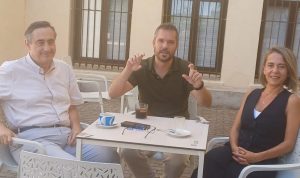 academic year, the Faculty of Education at Complutense University in Madrid (UCM) has offered training diplomas for individuals with intellectual developmental disorders, including intellectual disabilities (ID) and autism spectrum disorders (ASD). We sit down with Alberto Sánchez, one of the directors of the Liceo Diploma alongside Esther Rodríguez-Quintana, for a cup of coffee.
UCM team: In your experience, what are the most significant socio-emotional problems faced by people with ASD?
Alberto: I would almost separate the two concepts to give them both importance, but they are closely linked. People with ASD have difficulty recognizing emotions, both their own and those of others. This can lead to social problems. That is why it is important to work on both aspects. They are two related yet distinct issues.
In terms of addressing this, the emotional aspect should come first, such as recognizing one’s own emotions and those of others. However, the social aspect is also important, not only for people with ASD, but also for the culture. This should be addressed not only in centers, but also in classrooms, where children can learn what inclusion is and how to support people with ASD. Teachers can also incorporate emotions into their methodology.
UCM team: Given Liceo’s purpose of helping these persons enter the workforce, we suppose socio-emotional skill development is very important. Additionally, Liceo diplomas specialize in social care and health, which is aimed at caring for others. This demystifies the image we may have of these individuals.
Alberto: We work with people aged 17 and 18 and older, so their life experiences are important because they are adults. In those experiences, we see many differences in the socio-emotional sphere.
We approach emotions in a cross-curricular way. There is also a subject called cognitive workshops, but the aim is not to approach intelligence in a traditional way. Rather, we take a much more cross-cutting perspective. From this perspective, we explicitly work on recognizing emotions and simulate situations that may arise in the workplace. Then, during the 115 hours of supervised work experience, students apply what they have previously practiced through simulations.
We have observed how people with intellectual disabilities (ID) and autism spectrum disorder (ASD) interact and have noticed that many students with autism, perhaps because of their experience of being cared for, have excellent caregiving skills, especially with older people. They understand timing perfectly and teach us how to support others. This does not always come from asking questions or touching, but sometimes consists of providing accompaniment and respecting timing. In this respect, people with autism are the best.
UCM team: Do you think technology can be useful for developing these social and emotional skills? What is the training like in Spain for caring for children with ASD?
Alberto: I think new technological tools offer almost infinite possibilities, which is great. However, we have to be careful. I would place more emphasis on training families. We can’t expect to instill a methodology for using technology at school if at home it’s “when I want,” “when my parents don’t have time,” or “when they want me to be quiet.” We have to change the culture. If schools and families work together to use new technologies, they can be very beneficial. Technology makes it possible to improve training by offering options that are difficult to provide in a classroom setting.
In terms of training, I think there is still a long way to go. I believe schools adapt better than teacher training programs. Once they leave university, they are faced with a reality for which they are not prepared. I think many of them feel lost and insecure. At the UCM Faculty of Education, we have identified this issue and are addressing it in two ways: First, we offer training and awareness-raising to any group of students who requests it through the Liceo Diploma. Second, we provide practical experience with Liceo Diploma students. Meeting people with ASD helps demystify many aspects. Our experience shows that shared experiences help eliminate prejudices and stereotypes. This is the best way to prepare students.
UCM team: Thank you very much, Alberto, for your valuable comments.
Note: The UCM team of the EARLY-ASD project is composed of Gonzalo Jover, Esther Rodríguez-Quintana, and Laura Camas. The talk took place on July 2, 2025, in the cafeteria of the Faculty of Education at the Complutense University